Neither Backing Down, Nor Asking Him To
Short Story | By Kiki Sulistyo
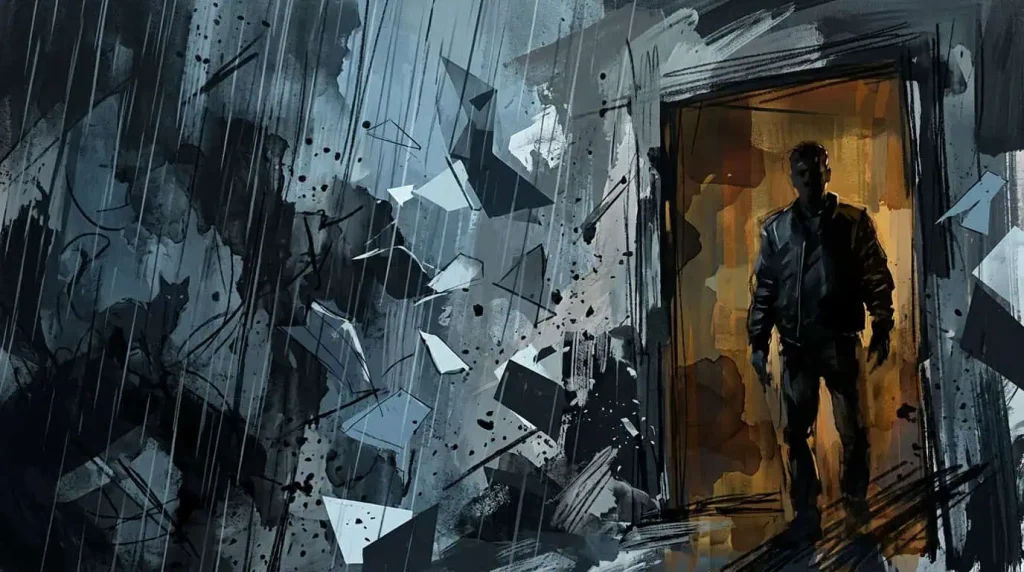
As October arrives, the rain begins to fall more often. The sun, spider-like, still spins its web of light across the morning, but by afternoon black clouds start marching in. It’s as if some phantom camera keeps snapping photo after photo — its flash followed by a rumble, as though the phantom camera were some old, heavy-geared contraption whose every blink demanded a mechanical churn, always leaving behind a creaking sound. Drops of water fall along with the damp wind that sways the leaves, the power lines, the laundry, the window curtains.
That same damp wind was tousling the hair of a man he saw standing at the door. Moments earlier, he’d opened the front door after hearing repeated knocking.
He didn’t ask who the man was. But neither did he invite the man in. The man wore a black bomber jacket over a black shirt, its hem peeking out to cover the top of his thighs. His jeans were also black and looked new, as did the plain black oxfords on his feet. His appearance drew no attention. If he walked through a crowd, no one would notice him. The man was like a part of the weather itself — a risk that inevitably comes with certain conditions, and therefore not worth paying attention to.
“Hello,” the man said, after they had stared at each other in silence for a while.
“Password?” he replied at once.
“May I come in for a moment? Just briefly.”
He weighed it over. The rain was growing heavier. In front of him — or rather, behind the man — a curtain of water seemed to have been drawn down. The spray was already reaching the porch. He saw droplets soaking the man’s shoes. He was about to close the door, but the man called out, “This is about Ramses!”
He hesitated. The door, which had been about to shut, swung back open. Finally, he let the man in, then quietly closed the door behind them.
Unlike when he’d crossed the threshold, once inside, the man seemed uneasy. He chose the chair facing the door, as if afraid someone might ambush him from outside. In an unfamiliar place, people always try to stay connected to the door, so they can run if something happens.
The host walked toward the telephone. J, his cat, was curled up on the same table where the phone sat. The host made a small motion to touch J’s ear. The animal woke, shook its head, and went back to sleep. The host picked up the receiver and dialed a number to reach someone. The call was answered; they spoke briefly. Now and then the host had to repeat himself, since the rain, growing heavier, muffled his voice. After hanging up, the host let out a huff.
“You didn’t call Ramses,” he said to the man.
“No, I didn’t. But I know something about him.”
“You know something…,” the host murmured, then, “So you know something, but you’ve never met Ramses?”
“That’s right. But I have to tell you.”
“Have to tell you…,” the host murmured, then, “I’d think you already know who I am. You must also know how little chance there is that you’ll be able to carry through with whatever you’re planning.”
“True. But I have some confidence that you’re a good man. A man who’s easy to work with.”
“A man who’s easy…” The host was about to go on, but the phantom camera went to work again and the creaking rumble rattled the window glass. J woke and immediately leapt down. The cat walked, first toward the host, but then, catching sight of the man, veered off and quickly began rubbing its neck against the man’s leg.
“A good man…,” the host murmured, correcting himself as much as repeating it, then, “What’s the use of looking for a good man?” He pitched his voice as though he were speaking to himself.
“It might sound unclear. But I think you can understand. Someone who goes looking for a good man must believe, deep down, that he’s a good man himself.”
“A good man…,” the host murmured, then, “Nobody who comes here is a good man. That’s exactly why this place was built.”
“I know. But I’m sure you don’t yet know what’s happening.” The man’s voice was calm now. He seemed to feel he had the upper hand. Usually, whoever came to this house knew less about the situation than the host did — now, it appeared to be the other way around.
“Don’t yet know…,” the host murmured, then, “That’s right,” the man answered. Now he picked up J, who had been rubbing its neck against his leg all this while. He settled the cat in his lap and stroked it. Suddenly the host was reminded of a scene from some movie, though he couldn’t recall which one. As the man kept talking, the memory of that film grew stronger, yet became harder to place. The way the man stroked the cat, and the way his speech had suddenly changed — tilting his mouth as if something were lodged inside it — made him look more and more like the figure from that film.
“I’m going to make you an offer you can’t refuse,” the man said.
That was, word for word, a line from a movie — but which movie?
The man rose and walked toward the host. He repeated the words, this time whispering them right into the host’s ear, so the host couldn’t hold back a shiver of ticklishness brought on by the breath and the words the man spoke. The host stood his ground — neither backing down, nor asking the man to. “An offer…,” the host murmured, and just as he was about to burst out laughing, the man beat him to it.
With one light motion, the man began spinning in place, swinging J’s body around as if in time with the gusts that kept battering the window shutters. The host stood watching the man’s antics. He began to sense that the man meant to toy with him — meant to show that there was a power behind him greater than the one standing behind the host. The host wasn’t about to lose. He started moving too. At first he stomped his feet against the floor, but since the sound was drowned out by the pounding rain, he began leaping about instead, spinning like an athlete. For a moment he saw the man freeze, staring at him. But only for a moment. After shrugging off his bomber jacket, the man resumed his dance, and this time, as he moved, he spoke:
“Do you really not recognize me? You called Ramses earlier, but it wasn’t Ramses who answered.”
The words startled the host. He had indeed called Ramses earlier, as he always did whenever a client came seeking help. Ramses was the host’s agent — everyone who came to him did so through Ramses. Including this man. Ramses had said earlier that the man already had the password from him, so everything was fine. Sometimes Ramses liked to toy with him, and he in turn sometimes toyed with his clients. He liked the feeling of being such an important anchor for the people who came to him. So when he’d told the man earlier that his guest hadn’t contacted Ramses, that had only been part of the game. The man had been lying — he’d clearly already gotten in touch with Ramses.
Now the man climbed onto the table and continued his dance. Without a second thought, the host leapt onto the telephone table too. He stomped his feet, harder this time, the noise crashing together with the sound of the rain and wind, and with J’s yowling. For a moment the host saw the man grip J’s throat, making the cat writhe. Then, all at once, the man flung the cat toward the host, who flinched away on reflex. J’s body slammed into the wall and dropped to the floor. The host recoiled at the sight of J’s body convulsing on the floor, as if the cat, too, had joined in the dance.
The man climbed down from the table. The host thought, for a moment, that the man would simply sit back in the chair. Instead, the man lifted the chair first, set it on the table, and then climbed up again to sit in the chair now perched atop the table. The man looked at the host and spoke again in that same manner — tilting his mouth as though something were lodged inside it. He said once more, “I’m going to make you an offer you can’t refuse.”
Now the host remembered the film — and remembered, too, the character from it.
Don Corleone!
“Well, now you remember who I am, don’t you?”
The host stood frozen. The man went on, “People come to this little house so they can save themselves. But anyway, doesn’t everyone want to save themselves? So that’s not the issue. Your job is the invisible link that keeps a certain system a perfect closed loop — a system that wants nothing except for the money to keep flowing. So when that flow of money starts to falter, the invisible link is the one to blame. You keep a great deal of data: fake diplomas, fake ID cards, fake passports, shady transfers into any number of accounts. Very few people understand that ghosts like you are exactly what allows idiots to sit in the halls of parliament, what makes everyone anxious over things that never deserved anxiety in the first place, what keeps everyone believing in so many things that have been convincingly proven to be lies. But make no mistake, I’m no hero. I don’t care. What goes through a person’s mind when they see an imperfect circle? I’m sure that person will busy themselves thinking about how to make the circle perfect. A system has to look imperfect so that people keep trying to perfect it, rather than deciding to cut it off. People don’t think that a ghost like you exists, because what they see is an imperfect circle, and they set about trying to perfect it. The trouble is, I’m a ghost too — though not just any ghost, but a ghost who hunts other ghosts. There’s never any trouble between fellow ghosts, until one of them starts showing itself within the circle. You surely don’t know that Ramses, your agent and also your partner, revealed himself within the circle over something utterly trivial: his nephew got beaten up abroad. A trivial matter can tear apart an entire order; a small incident can crack open a much larger truth, and that’s exactly where the problem lies. A nephew who got beaten up — and in truth, suffered only minor injuries — led a ghost hunter to names. Not the names of the culprits, but the names of those who know. Ramses has a list of those names, and he’ll probably use it to save his nephew. If Ramses knows those names, then you must know them far better. Are you following so far? Now, here is the offer you cannot refuse: you will surface, take someone’s place in the government, and let another ghost take your place here — or I will erase you from the circle. Everyone would surely agree, erasing something invisible is very easy, isn’t it? Everyone would even call me crazy if I told them I’d just erased something that can’t be seen.”
Outside, the rain was slowly letting up, though the wind still worked at rattling the window shutters. Meanwhile, slivers of light began pushing through every crack in the house. The air felt the way it does when night has only just slipped away and morning is still sliding out from its hiding place. The host looked at J, who had stopped convulsing. A moment later, the host thought he saw the cat rise out of death itself, stretch, and start to meow. Perhaps what the man had said really was true: it hadn’t been Ramses who answered the phone earlier, but some other ghost. An unseen ghost, replacing another unseen ghost. Everything began to feel like an illusion to the host as he heard the man say, “Now, give me that list of names….”