Payakumbuh Poetry Festival (27—29 November 2025)
Exploring the Worlds Within Poetry
“I prefer poetry,
where I have the freedom to imagine …”
— Museum of Poetry (Namal Siddiqui)
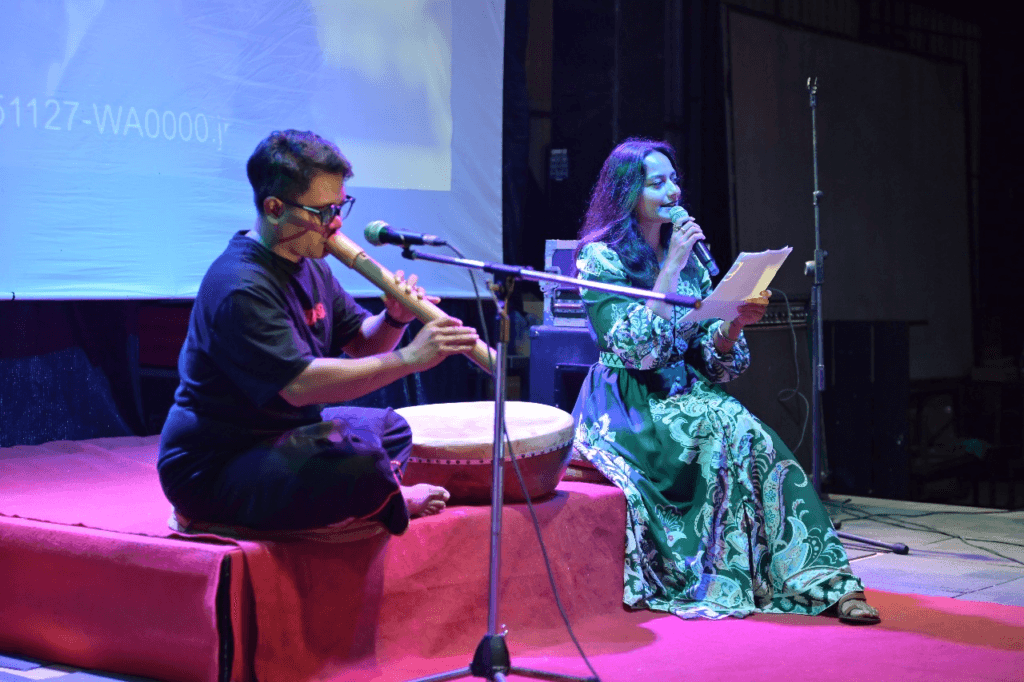
Excerpts from the Pakistani poet’s work seemed to bounce around Agamjua Art and Culture Café in Payakumbuh. She read accompanied by traditional instruments played by Afdhal Zikri, a musician from Agam Regency, West Sumatra.
For thirty minutes, the two collaborated. Namal read three poems from a collection that will be published next year. Afdhal played the dikie pano and sampelong. The two responded to each other. The two echoed each other. The audience seemed mesmerized. Although Namal and Afdhal’s “language” may not have fully penetrated the soul. Namal, a poet who grew up in Dubai, talked a lot about recent social issues. For her, poetry is a way to voice the anxieties she experiences and sees, and to convey them beautifully.
Beautifully? Voicing anxieties? It sounds ironic. As Namal said, she is both lucky and “cursed” to be able to write in English. Meanwhile, in another part of his heart, Urdu, her mother tongue, demands its share like the waves of the sea.
However, that is how poetry comes to be. How verses arranged with aesthetics occupy the pinnacle of literature. Sometimes poetry continues to spread its wings of “reflection” without the need to truly understand its content. With that foundation, the Payakumbuh Poetry Festival (PPF) was born.
Starting from Poetry
On Wednesday, November 26, 2025, it was still raining heavily. The clock showed half past seven, and I was anxiously looking at my phone. That morning, I had no idea how many times my order had been rejected by online taxis.
Ten minutes later, I finally breathed a sigh of relief, though my clothes ended up slightly damp as I moved my belongings into the trunk of the Ayla. At the same time, my phone rang; another car was waiting for me.
By eight o’clock in the morning, I was in another car on my way to Payakumbuh City, the only place in Indonesia where a poetry festival is consistently held: the Payakumbuh Poetry Festival (PPF).
This festival was initially conceived by friends in Payakumbuh during the COVID-19 pandemic in 2020. Roby Satria, director of PPF, stated that the first program of PPF was a national poetry competition initiated by the Tanah Rawa Community, a literary group based in Payakumbuh. One of West Sumatra’s senior poets, Iyut Fitra, is also part of this community.
The online program continued until 2021, when PPF was held offline in 2022. That year, PPF received support from a member of parliament, Supardi SH. In 2023, PPF invited poets not only from Indonesia but also from Southeast Asia, such as Singapore, the Philippines, Thailand, and Vietnam, to participate in PPF.
The 2025 PPF event was officially opened on November 27, 2025, at 8 p.m. by Mardion Fernandes, a member of the Payakumbuh City DPRD. Before that, the event began with an alua pasambahan performed by KAN Kelurahan Padang Tangah. Two traditional leaders took turns reciting petatah-petitih (traditional sayings) and then closed the ceremony by chewing sirih pinang (betel nut) in carano.
Unlike the galombang dance or pasambahan dance, which are usually performed to welcome guests, this oral tradition of basilek lidah is generally used to begin a sacred deliberation or a major event. Not only that, “Alua pasambahan is more appropriate,” said Roby, “because it is traditional poetry.”
From the opening, this reflected the theme of this year’s PPF, namely “Antardunia dalam Puisi” (Interworlds in Poetry), which explores the worlds that exist in poetry. The committee made a special effort to highlight the treasure trove of poetry. Whatever the form of performance or output of the festival or programs within the festival, it was always related to or derived from poetry. This includes both traditional Minangkabau poetry and the landscape of modern Indonesian poetry today.
PPF attempts to open up possibilities for poetry to take forms other than text, such as sound poetry and visual poetry. This is the main foundation. Both were held in advance as pre-festivals. The format is a workshop held on November 19-21, 2025, in Padang.
In the discussion “Antardunia dalam Puisi” (Interworlds in Poetry) with Donny Eros and Roma Kyo Kae Saniro, poetry, visual arts, and performing arts are not only forms of entertainment but also learning spaces that help young people develop creativity, courage, and a broader way of thinking. This activity reminds us that art is an important part of the lives of the younger generation. Art helps us see the world from a deeper perspective, understand differences, and express ourselves in a healthy and meaningful way.
Poetry Workshop, Poetry Discussion, and Poetry Reading
On the second and third days, PPF also held a poetry writing workshop for students throughout Payakumbuh City with the winners of the PPF poetry manuscript competition; discussions on poetry, children, and education outside of school; a discussion of PPF’s selected poetry book (LS) Kutu-Kutu Joni; a discussion of interworlds in poetry; a discussion of PPF’s selected poetry book Suatu Hari di Batas Ilmu Pengetahuan (One Day at the Edge of Knowledge); and finally, a discussion of the jury’s accountability.
Initially, for the workshop, the committee scheduled the five winners of the best manuscript competition to conduct workshops at predetermined high schools, as in previous years. However, due to the disaster that occurred in West Sumatra as a result of bad weather, the agenda had to be canceled because the four winners of the competition, except for Badrul Munir Chair, were stuck in Padang. To work around this, the committee changed the workshop format so that they no longer visited schools. Instead, several representatives from each school came to Agamjua. The other participants joined the discussion via Zoom.
The workshop discussion was lively. Participants were enthusiastic when the question and answer session began. Led by Randi Reimana with Badrul Munir Chair as the guest speaker, Badrul answered 27 questions directly. Participants were very happy with this program, one of whom was Izzatun Nafsiah, a student from SMA N 1 Payakumbuh. In an interview, Izza—as she is commonly called—revealed that she had just realized that writing was not as easy as it seemed. There were many things to consider, and through this workshop, Izza learned how to capture ideas and turn them into writing.
The discussion on “Poetry, Children, and Education Outside of School” was no less interesting. It was led by librarian Nisya Tri Yolanda with two speakers: Yona Primadesi, an academic and practitioner in the field of literature, particularly children’s and youth literature, and Della Nasution, an artist in the field of theater who was present in person because she lives in Payakumbuh.
According to Yona, children tend to see the phenomena around them clearly. Therefore, one method that can be used to teach children to write is through field observation. For example, taking children to a place, whether it be a market or a forest. Upon returning home, we can ask them to recount what they saw, and from there, children’s stories will emerge. This innocence is seen as one of the most effective methods for stimulating children’s critical thinking and imagination in a simple way. Indirectly, this is done through education outside of school.
Sound Poetry and Visual Poetry Adaptations
PPF 2025 will also feature videos of the best sound poetry and visual poetry adaptations. These videos aim to introduce the public to other forms of poetry adaptations that are rarely discussed. They are a creative attempt to explore the world of poetry. As sound poetry emphasizes sound and rhythm in its expression, it will certainly be interesting to introduce it to the public attending PPF 2025.
Sound poetry often uses words that seem meaningless or are pronounced unclearly in order to evoke emotions. At the very least, this is a new medium that deserves appreciation from the public through PPF.
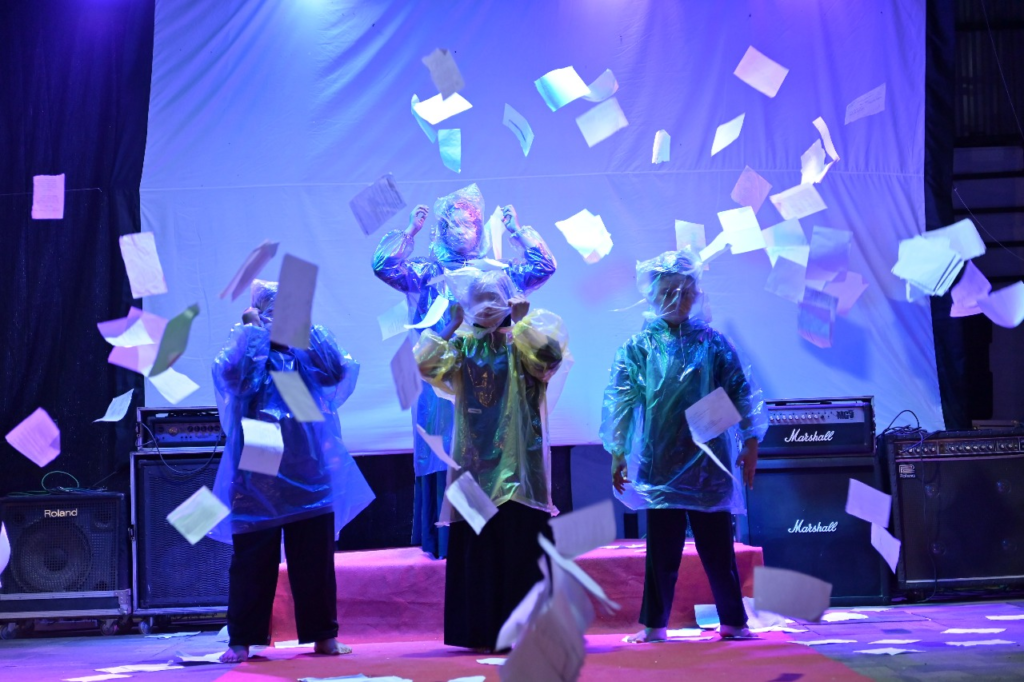
The same goes for visual poetry, which is a combination of text and visuals that become a source of meaning. Here, the audience is introduced to text that has been transformed into visual objects. This has actually been known for a long time; in Arab culture it is called calligraphy, while in Western culture it is called calligram. It has been around for centuries.
Although most of the audience felt unfamiliar and confused, they still enjoyed themselves while thinking and asking questions. One of the audience members, Dandri, was heard saying to his friend, “What kind of poetry is this actually?”
The event then continued with a dramatic performance of poetry by children from the Intro Payakumbuh Art Community. Then, the winners also read their respective poems contained in the poetry manuscripts they had submitted.
“Volunteers” The Lifeblood of the Festival
Namal actually had its own discussion. However, considering the weather conditions, the committee prepared a radio broadcast in anticipation. PPF curator S Metron Masdison was the questioner. Zulkifli Sangroyan from the Festival Strengthening Team was supposed to be the moderator. The participants were communities from Payakumbuh City, 50 Kota Regency, Bukittinggi City, and Agam Regency. However, the situation dictated how much rice there was, and that was what would be cooked. The theme remained: Festival Ecosystem Management.
Metron’s important question was if Namal became the curator, what special program would he prepare. “Oh, that question,” he said with a smile. It was indeed a repeat question. The first recording had failed. The audio disappeared from the master computer. On that bright Saturday afternoon, the recording was redone.
He imagined PPF inviting the younger generation to sit together. Discussing what they imagined. It could be through discussions, workshops, or conferences. “You have the place. Hold an event once a month. Serve delicious traditional food. Invite some people to read poetry and so on.”
And what came to mind next was when Namal said, “Volunteer, Metron. Find as many as you can. Because that is the lifeblood of the festival.”
So, see you at PPF 2026. ***
Bunga Suci Pertiwi, enjoys writing essays, narratology,
researching habitus and arena in literature.
*)This article was published in cagak.id on Desember 8, 2025.