The 13th International Festival Al-Mutanabbi, Zurich (Switzerland, 1—4 November 2014)
From Arabia to Sumatra
“ARE you Al Mutanabbi?” Questions like this can still be heard today from children on the streets of Baghdad, Cairo, and Damascus when someone uses elevated language, the language of poets, beautiful language that is not commonly used in everyday speech. Thus, Al Mutanabbi lives on even though the poet died in 965. In Arab countries, everyone knows him, whose full name is Abu at-Tayyib Ahmad ibn al-Husayn al-Mutanabbi. He was born in the city of Al Kufah in Iraq. For centuries, there were only two books in Arab homes: the holy book, the Qur’an, and Al Mutanabbi’s book of poetry, Diwan. He was not only a poet but was also considered a wise prophet.
“If you see a lion’s teeth when it bares them, do not think that the lion is smiling at you.” This is one of Al Mutanabbi’s famous quotes. Or this simpler one, “Battle and sword, paper and pen,” which shows courage and strength in battle, as both a legacy and a source of pride in Arab heritage. Another line from his poetry reads, “Oh, sword that is never sheathed, there is no doubt that you offer no protection,” about respect, friendship, courage, and bravery.
Since 2000, a number of Arab poets, artists, writers, journalists, and translators have initiated a Swiss-Arab Cultural Center in Zurich. It has become the largest Arab cultural community in Europe. By taking the name of the great Arab poet, they intend to rediscover poetry from within its niche by holding an annual poetry festival, according to the festival’s director, Ali Al-Shalah. The festival director, who is also a poet, translator, journalist, and member of parliament from Iraq with roots in two countries, Baghdad and Zurich, said, “Now the world is too full of politics. It is time for us to return to our ancient heritage, an early form of Arabic literature, the oldest literary work: poetry.”
This year marks the festival’s 13th year, a number they also consider “unlucky.” The committee invited a big name, Adonis! The day after the festival ended, Adonis’ face was featured on the front page of Switzerland’s largest and oldest newspaper, Neue Zürcher Zeitung. There, the poet (now 83 years old), whose real name is Ali Ahmad Said Esber and who has been nominated several times for the Nobel Prize in Literature, said, among other things, “A text ultimately depends on its readers. If it is read in a spirit of openness, measure, and humanity, then it will become a great text; if not, it will become small, including in this case the Quran.”
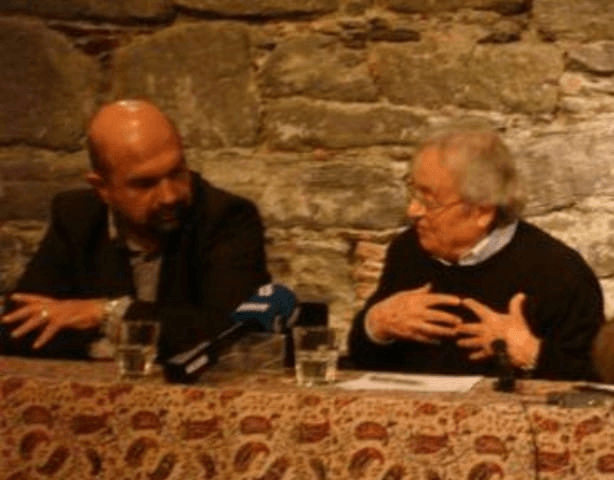
Adonis, a Syrian poet who calls himself a “permanent exile,” is known as the most provocative and daring Arab poet. In a special interview with reporters during the 13th International Al-Mutanabbi Festival, he also reiterated his disagreement with the East-West dichotomy. “Where is the difference between Hafez and Goethe when we talk about creativity, when we compare Zaha Hadid and Mario Botta? Globalization has clearly created equality. And in Arab countries, poetry is still important. In the West, however, many people have surrendered to the power of the internet, images, the entertainment industry, mass media, changes in cultural understanding, and readers are far removed from the creative process. But I think as long as love exists—as long as there is love—there will be poetry,” he concluded on a hopeful note, even though Syria is still experiencing cruel and inhumane acts of violence.
Adonis visited Indonesia in 2008 and gave a lecture on religion and poetry at the Salihara community. His poetry has been translated into Indonesian and published several years ago. Here is one of his poems:
“We have caressed the body of the earth with our eyelashes, we have tied flying flowers with our veins, we have also washed the daylight. These are our paths—we marry lightning, we fill the earth with the cries of new things.”
Another famous poet who attended was Eugen Gomringer. He is an 88-year-old poet from Switzerland who is known as the father of concrete poetry. Before reading his poems, he joked, “I am proud of this (pointing to his ID card, made of thick paper covered in plastic, an ordinary identification card with a standard design, given to him by the committee, which he pinned to his chest) and I deliberately walked around the city wearing this emblem,” he said, making the audience “giggle” on that cold autumn evening. This poet has received several awards. Most recently, in 2011, he received the Alice Salomon Poetry Prize in Berlin. Among other things, he read, “from the edge/inside//inside/to the center//through the center/middle//outside/to the edge”. According to him, concrete poetry is a form of literature in which the arrangement of words on the printed page is as important as the poem itself. For example, his poem about the wind shows letters scattered as if carried by the wind.
Sumatra
The poetry festival held in Zurich was impressive as a relaxed festival with a family atmosphere. The poets only had to attend the evening event, which was the poetry reading. The rest of the time, we could all enjoy the river that runs through the middle of the city, where boats sometimes pass by. Or, a short walk from the hotel where we were all staying, there was a calm lake with white swans, seagulls, and phoenixes flying low overhead. The poetry reading venue at The Theatre Stok also supported the intimate atmosphere because it was located in a basement room that already looked artistic without any special sound treatment. The venue already had a unique sound resonance. But more importantly, there was plenty of time to establish communication between poets, which was more valuable than a poetry festival event.
For example, from a young poet (29 years old) from Belgrade, who is also a philology lecturer, Jan Krasni, I learned that in his country, Serbia, many people are familiar with a poem titled “Sumatra.” Indeed, the island of Sumatra is the most famous exotic island and has been the dream of many artists around the world and Europeans in the past. However, in Serbia, we certainly did not expect that there would also be a poem about this Indonesian island. The poem was written by Milos Crnjanski, a Serbian poet born in 1893. Here is the poem: Now there is nothing else on our minds, only a feeling of softness and relief/Let us enjoy this emptiness, the snow, the peaks of the Ural Mountains// If we feel sadness at the pale figure/when we feel loss on some nights/we know that somewhere, a tributary/even everything, colored magenta, is flowing!// Love, one morning in a foreign land/surrounds the soul, ever closer/in the peace of the endless blue sea/glittering crimson coral/like in my distant homeland, with its cherries. We lie awake late at night, smiling fondly/at the crooked, curved moon/our hands gently touching distant hills, softly/caressing the ice mountains.
The poem was written by the poet in 1920. At the beginning of World War I, Crnjanski was an unfortunate young soldier who had to be on the front lines in Galicia against Russia. Then he also went to Zagreb and Belgrade. He spent a lot of time alone in the war hospital. In a note about the poem, Crnjanski wrote, “It all happened at the station in Zagreb … staring at the dark window, I remembered a friend who described the snowy peaks of the Ural Mountains, where he spent a year in a prison camp … he also told me about his lover. I only remember his story about his lover’s pale face and how he repeated how pale she was when he last saw her…. The train had just reached the peaks of Frushka Gora. Several branches knocked on the broken window glass. Damp, wet, the cold scent of trees began to enter the train and I could hear the murmur of a river. We stopped in front of a ruined tunnel… I wanted to see the river that continued to murmur in the darkness, and I had the impression that the river was a cheerful magenta color. My eyes were tired from lack of sleep due to the long journey… We had to climb the tunnel at Chortanovci and walk to the other side… When we finally climbed the hill, below us we saw the Danube River, gray, blurry. All fog, behind it was a sense of the sky, endless, infinite. Green hills, like islands on the land, disappearing into the dawn’s crack…. And my thoughts…. The blue sea, remote islands I’ve never known, red plants and coral, which I may only remember from geography, all kept swirling in my mind…. Tired, I sat in a gloomy corner, alone. Several times I repeat to myself: Sumatra, Sumatra! I think: how will my homeland welcome me? The cherries must be ripe on the trees, and the villages full of joy. Look, how even the colors, all the paths to the stars, are the same, on the cherries, on the corals! Ah, how everything can be connected in this world. “Sumatra,” I said again, mocking myself. Suddenly I trembled. Some turmoil within me… I also saw the moon, shining brightly. I felt helplessness and sadness. “Sumatra,” I whispered. All the complexity turned into endless peace and solace.
War and poetry…
Finally, the classic question arose again, as posed by a reporter at the press conference for the Al-Mutanabbi International Festival: can poetry change the world? And this was Adonis’ answer: “Poetry does not change anything directly. But poetry can present a new image of the world, and that can bring about change in the reader. Then it is up to the reader themselves whether they will change the world.”
Dorothea Rosa Herliany, poet
*)This article was published in the Sajak journal on March 3, 2014 edition.