Babylon Festival for International Cultures and Arts (March 21—29, 2014)
Poetry, Sadness, and Passion

A teacher asked students to draw whatever they liked/the principal’s child drew a new Chevrolet car/the real estate developer’s child drew a market and hotel complex/the politician’s child drew an armored car/a female student whose father was a newspaper delivery boy drew a piece of bread.
(Poem by Iraqi poet, Lateef Helmet)
Poverty, armored cars, barbed wire blockades, and security teams with weapons at the ready, stood side by side at a cultural festival in Babylon at the end of March. Another poem, also by an Iraqi poet, is even more poignant:
The sea snatches our dreams/packing them in tears/life feels like withered leaves/roasted by the scorching sun/until they are burned to ashes/now the fire licks our names/embroidering them into fragments.
(Munthir Abdul-Hur)
Babylon, we know it as an ancient historical city. Emperor Nimrod, the first most powerful ruler, leader of various nations of the world with one language that could be understood by all mankind—and therefore earned the nickname “the mighty one on earth”—one day around the 2nd century BC ordered his people to gather stones and bricks, build a city, and construct the tallest tower whose peak could touch the sky: the Tower of Babel. God was angry at his arrogance, so he scattered the people so that the various nations of the world would have different languages. Centuries later, Babylon reached its golden age during the reign of King Nebuchadnezzar with military and religion as its strengths. It was also during this era that the famous hanging gardens were built, which are said to have had intricate terraces, magnificent water features, and floating plants.
In the centuries that followed, due to various wars, looting, conquests, and destruction, ancient Babylon was eventually reduced to ruins. Babylon, once the center of civilization, science, philosophy, history, medicine, mathematics, almanacs, astronomy, architecture, and the world’s most important trade route, had lost its glory and prosperity of the past. The Epic of Gilgamesh, an epic poem from Mesopotamia, Enkidu, the half-human, half-animal, and the beautiful queen Ishtar, have also disappeared after several copies of the literature were found in the ruins of the 7th century BC during the reign of King Ashurbanipal. Now, only one or two soldiers guard the site.
Meanwhile, “modern” Babylon is a city like any other city in the world—about a 2-hour drive from Baghdad. After the fall of Saddam Hussein’s dictatorship, Babylon is now rebuilding itself from the ruins of war. The city looks poor. Corruption and cronyism are rampant. Public services are poor. Infrastructure is inadequate. Many roads are unpaved. Dust swirls around like in old cowboy movies. None of the vehicles are shiny; they all look dirty from the road dust. There are still few hotels and restaurants, and service is poor. Public transportation is almost non-existent. Plastic trash is everywhere. Many roads, mosques, and other places are closed and guarded by soldiers.
However, despite various limitations, a cultural festival with an “international” theme was held. A number of writers, painters, musicians, theater artists, filmmakers, and other artists came from various cities. Dozens of poets from various countries such as Egypt, Lebanon, Syria, Yemen, Iran, other Arab countries, as well as Turkey, Indonesia, England, Germany, Persia, Spain, and others performed poems in their respective languages. Modern Babylon seemed to be transformed back into ancient Babylon, with poets united in one language: the language of poetry. Poetry can serve as a bridge of communication between communities of nations. There is tolerance, mutual respect, and the deepest values of diverse cultures are discussed. Poetry recitation, which has been a mainstay of culture for centuries, was revived.
Dr. Ali Al Shalah, a poet born in a village not far from the ancient city of Babylon, translator, journalist, and member of the Baghdad parliament, discovered a damaged ancient Iraqi house with a basement, which he bought and repaired. There, he established the Mesopotamia Foundation, which oversees the House of Babylonian Culture, now a center for various cultural activities and the restoration of ancient buildings in the city of Babylon, one of whose activities is organizing this international Babylon festival. This festival actually existed during the time of Saddam Hussein, but the festival was mostly used for the President’s political propaganda. When Saddam fell, Ali, supported by a number of cultural institutions and academics, initiated a festival that was more pure and not influenced by other interests.
On the first day of the festival, March 21, 2014, poetry was recited as a song of freedom that allows us to build a better world using words as a means of expression, in line with the universal message of UNESCO, which designated this date as World Poetry Day. Dr. Ali Al Shalah, director of the Babilonia festival and also director of the Al Mutanabbi poetry festival in Zurich, Switzerland, said, “Today we are also celebrating Iraqi Mother’s Day. Mothers are the true heroes of all civilizations. Through this festival, we want to celebrate a new Babylonian era, bringing a thousand colors of enlightenment from the midst of a dark journey, celebrating an era of renewed knowledge. We want to listen to ancient and modern voices, works from new and more experienced artists. We are looking for new books and translating foreign works. We want to offer the hospitality and warm embrace of a big family.”
Time moves in tandem with the flow of rivers. The Euphrates, considered the mother of all rivers in the world; the Thames in England, the Nile in Egypt, the Karaj and Jajrud in Iran, the dry river of Yemen often called Saila, the Neckar and Swabia from ancient Roman times, to the Mahakam, Memberamo, Bengawan Solo, Batanghari and others in Indonesia, are all said to be tributaries of the Euphrates. It was on the banks of the Euphrates River that the Babylon III Festival was held; in spring, with temperatures of 20 degrees and nights that were often even colder, it was a harmonious blend of beauty and contemplation, brotherhood, new life, enthusiasm for the future, dreams, dignity, tolerance, and peace for all nations of the world.
In the morning, there are painting and photography exhibitions, interviews with print and electronic media, discussions at universities, and tours closely guarded by security personnel prepared by the committee. However, bombs can be dropped at any time by terrorists, and international events like this, according to an Iraqi journalist, could be easy targets to attract the world’s attention.
Despite feeling apprehensive, we felt quite safe. Throughout the event, festival participants’ taste buds were treated to Arabic dishes, all of which had a goat flavor: goat milk butter, goat cheese, and kebabs, or goat meat and liver, cut into large pieces and skewered on long metal skewers. These were accompanied by khubz, a traditional Sumerian bread recipe that has been passed down from generation to generation. Then, vegetables were cooked in vinegar as a salad and soup with parsley, turmeric, and sesame oil, and the meal was rounded off with thick, sweet Arabic tea, served in small glasses; a finale that seemed to lock our stomachs shut.
Starting in the afternoon, amid the sounds of vehicles from the souq (traditional market) located next to the Babel cultural center, and the call to prayer at sunset, there were a number of book launches and poetry readings. The evening continued with poetry readings in a quieter courtyard. Later in the evening, there was a film screening. This year, among others, Mohammad Aldaraji’s film, In The Sands of Babylon, which won the award for best film at the Abu Dhabi film festival, was screened. It is a sad film that tells the story of the cruelty of war during the Gulf War, but it is beautifully and poetically packaged. The director and a number of actors were invited, attracting the attention of the general public. On another night, short films about children were screened, namely Lipstick, Nesmos Birds, War Canister, Children of War, and Children of God.
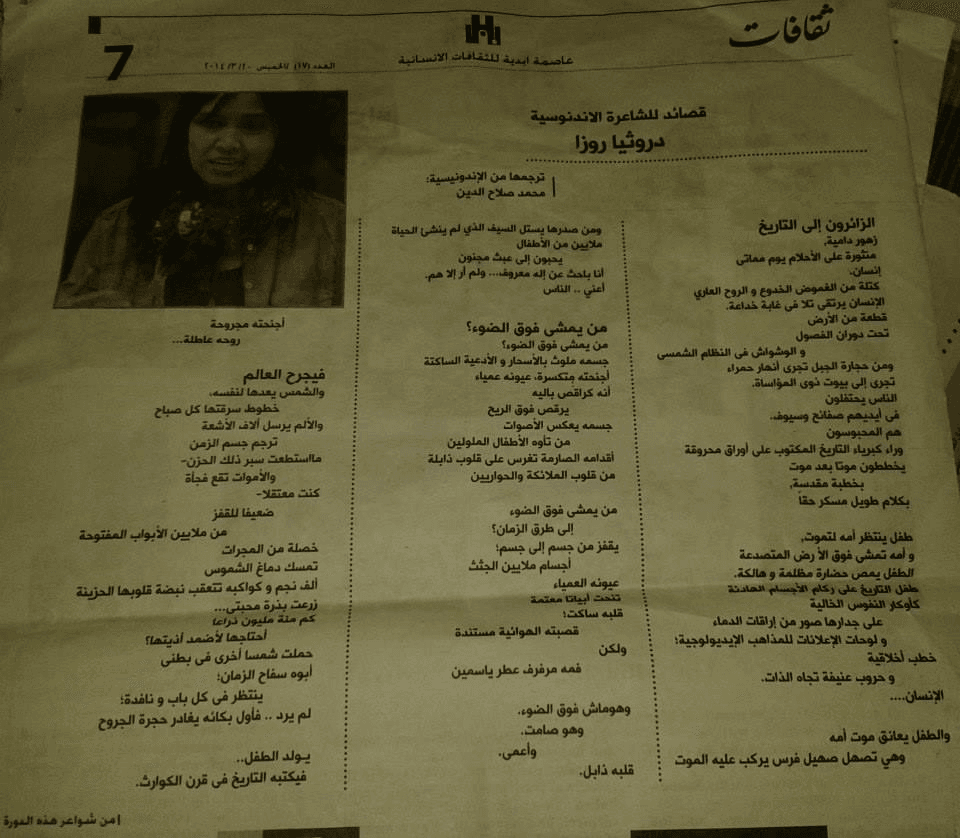
Not many women attended the evening performances. Most of the audience were men. But many children from the surrounding villages came. They watched the non-Arab guests perform with curious eyes, rarely seeing foreigners. Similarly, in theater performances, there were only one or two female actors. When they did appear, they had no lines to speak. A female artist from Stuttgart who comes to this festival every year said, “Women here are not allowed to dance. Not allowed. If there is a dance event, I am the only woman who dances,” she said with a laugh.
During the reign of President Saddam Hussein, who claimed to be the descendant of King Nebuchadnezzar, he ordered the reconstruction of the splendor of Babylon. On a hill not far from the site, he also built a magnificent palace with hundreds of rooms, thousands of square meters of marble, and bathrooms with gold-plated pipes, while his people were poor, suffering, and deprived. Now everything is empty, only the buildings remain. All the rooms are full of dust, there is a lot of unused wood lying around, and the floors are covered in bird droppings. Looking at the ancient Babylonian artifacts and Saddam Hussein’s palace, we see a glimpse of a glorious era, of power and tyranny. Meanwhile, from the Babylon Festival, we can see what is called spirit. The spirit of organizing a literary and cultural festival amid limitations, poverty, sadness, and an unsafe situation due to the threat of terrorism. The poetry reading seemed to be the event that most excited all the participants.
Ideally, art (literature) festivals should also be held in every city in Indonesia. Only art and literature can provide a momentary pause for us to calm down and reflect at every stop along our journey. An arts (literature) festival would be a period of experience, a chance to step away from our usual environment and routines to come together as a group, share feelings, renew our lives, and fill them with fresh, invigorating energy, giving us more vitality. Wouldn’t you agree? ***
Dorothea Rosa Herliany, poet
*)This article was published in the Jawa Pos daily newspaper on May 11, 2014.